
Cover for Einaudi
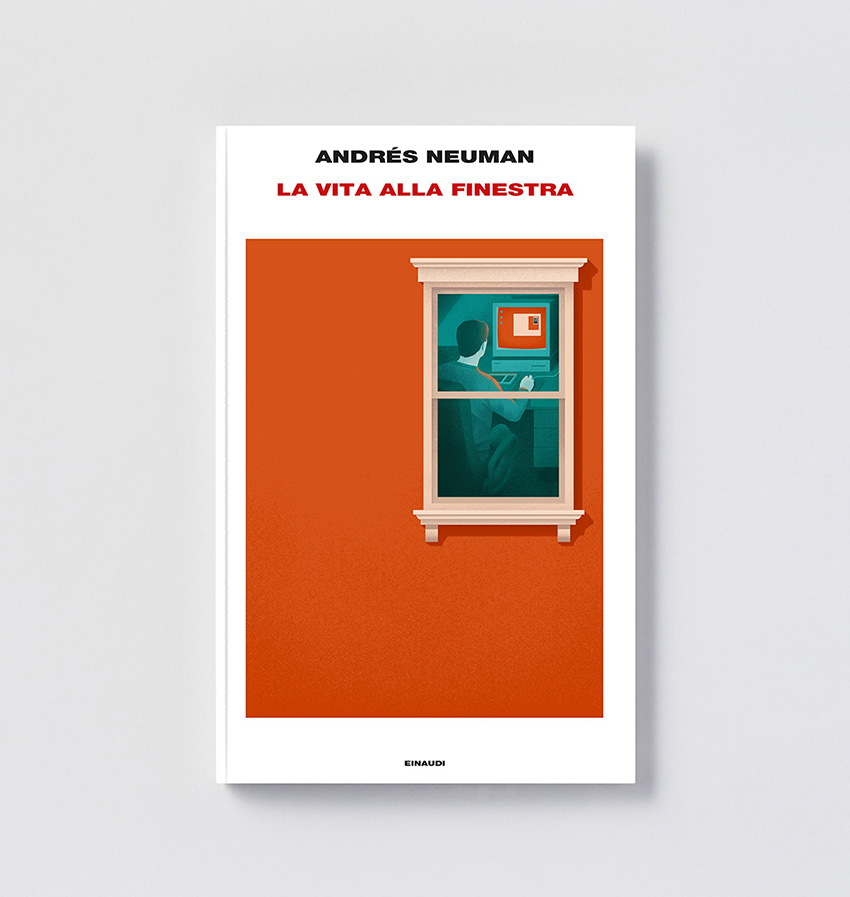
Illustrated cover for Einaudi for the book titled "Life in the windows" written by Andrés Neuman.
The book
Early 2000s, a Spanish city like many others. Net, a boy like many others, writes. Bent over his computer, he types long emails that he addresses to Marina. Night after night, to the windows that open on the screen, Net delivers the story of his days, between the crumbling and shaky recomposition of his family, the discovery of love, the anxiety for the uncertain future. But Marina, untraceable and almost as mysterious as the virtual universe, never responds…
Net lives in a city like many others, in a family with some problems – but what family doesn’t have them? -, he is enrolled at university but doesn’t attend, he has few friends, all more or less tormented and disillusioned like him, and in general life seems to him an expanse of boredom and intolerance. But what we know about Net, about the arguments between his parents, about his sister Paula’s sentimental ties, about the nights of excess with Xavi, about Sunday lunches at his uncles’ house, about the meeting with the bold Cintia who is impossible not to fall in love with, is only what Net decides to write to Marina. Perhaps an ex-girlfriend or a distant friend, perhaps an imaginary interlocutor, Marina is an indistinct presence who exists only in a web of memories and emotions that Net weaves with the emails he sends her. “Perhaps we feel the need to conceive on the screen the narrative perfection that is missing from our lives,” Net reflects: the Windows windows then become the symbol of his urgency to tell, to fix in the virtual world the version of himself and others that he sees from his perspective. And that will be irremediably deceptive, as, after all, the fruits of narration always are. But it is from another type of window, the real ones, those of houses, that Net observes the life that flows in the streets, in the courtyards, in other people's rooms. Only in this way, by taking one's eyes off the screen, does the meaning of everything reveal itself in all its ineffable simplicity. Published in Spain for the first time in 2002, and reprinted in 2016 in an expanded and revised version by the author, Life at the Window is one of Andrés Neuman's most beloved and successful books: in this intense ultramodern epistolary novel, fiction, the virtual world and lived experiences interpenetrate in a tortuous game of mirrors and identities that is very reminiscent of the dynamics of relationships in our millennium.
I've Worked With:


